
The Department of Civil Engineering at the Federal University of Technology, Minna (FUT Minna), established in 1986, is a leading hub for engineering education and research within the School of Infrastructure, Process Engineering and Technology (SIPET). Committed to global excellence, the Department delivers high-quality training through its B.Eng., PGD, M.Eng., and Ph.D. programmes, designed to equip graduates with the knowledge and skills required to address complex infrastructure and environmental challenges. With strong emphasis on innovation, digital engineering tools, and interdisciplinary collaboration, students benefit from a modern curriculum supported by advanced facilities, including a dedicated software design studio. Core specializations span Structural Engineering, Water Resources and Environmental Engineering, Geotechnical Engineering, and Transportation Engineering, areas critical to sustainable development worldwide. The Department actively promotes research, industry engagement, and the application of Information and Communication Technology (ICT) in engineering practice. Through these efforts, it continues to produce globally competitive engineers and researchers who drive sustainable infrastructure development, contribute to technological advancement, and provide impactful solutions across Nigeria and the international community.

The Department of Civil Engineering, Federal University of Technology, Minna (FUT Minna) was established in 1986 as one of the pioneering departments within the School of Engineering and Engineering Technology (SEET) as the school/faculty was then known. Starting with a modest student population, it admitted its first set of undergraduates in the 1986/1987 session and produced its first set of graduates in 1989. Under the leadership of its foundation Head of Department, W. Baranski (1985 – 1988), the department simultaneously launched specializations in Geotechnics, Transportation, Water/Environmental, and Structural Engineering. In 2017, following a restructuring by the University Senate, the department was moved to the newly created School of Infrastructure, Process Engineering and Technology (SIPET) to focus more deeply on modern infrastructure solutions. Since its inception, the department has graduated over 35 sets of engineers and significantly expanded its academic offerings to include PGD, M.Eng., and Ph.D. programmes.
Chronicle of Leadership (Heads of Department)
Vision
Our vision is to revolutionize the practice of civil engineering such that ultimate utilization of modern information and communication technology takes a centre-stage in the profession.
Mission
Our mission is to establish a centre of excellence in the training of high-level personnel and conducting research in civil and environmental engineering, at a level comparable with the best in the world.
Civil Engineering, the profession of designing and executing structural works that serve the general public, such as dams, bridges, aqueducts, canals, highways, power plants, sewerage systems, and other infrastructure.

Highway engineering is a branch of civil engineering that involves the planning, design, construction, operation, and maintenance of roads, bridges, and tunnels to ensure safe and effective transportation of people goods and services
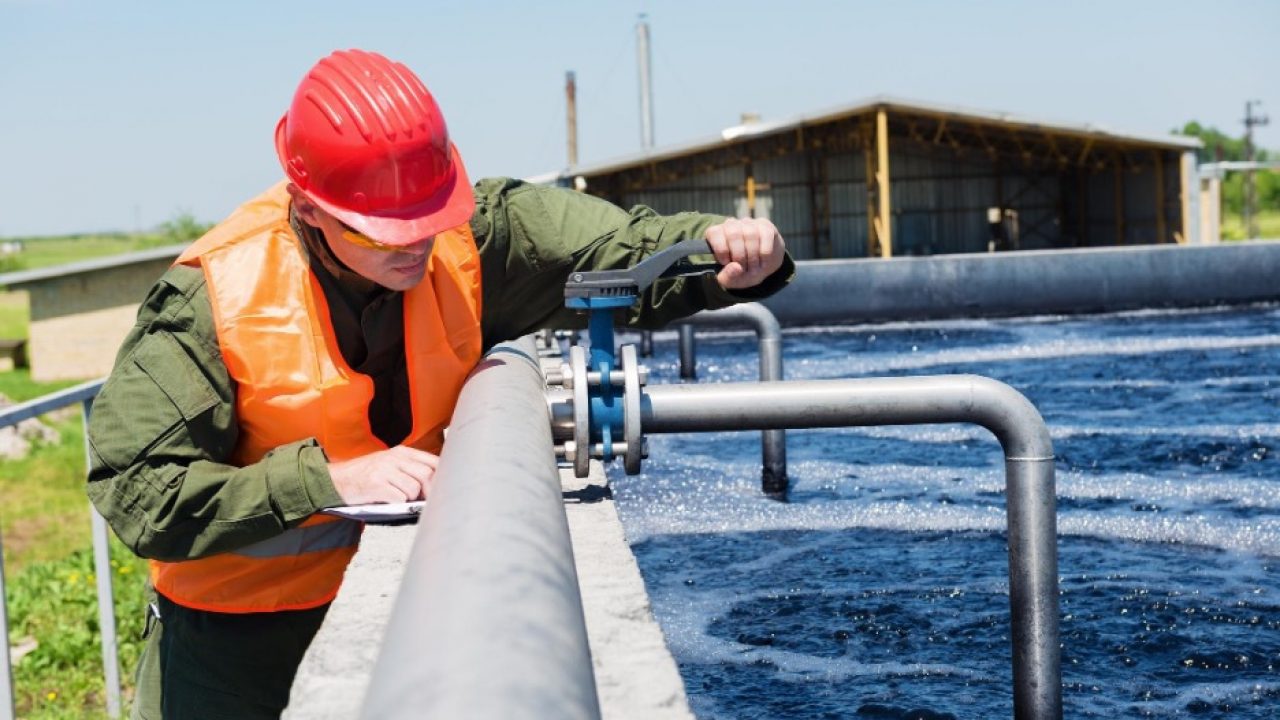
Environmental and water resources engineering is a broad discipline dedicated to addressing environmental issues in air, water, and soil
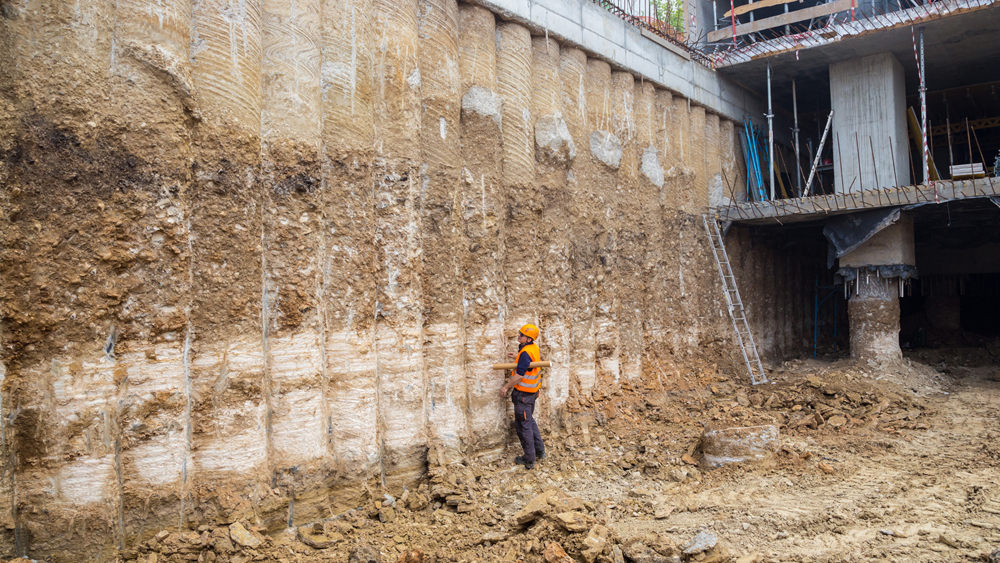
Geotechnical engineering is the study of the behaviour of soils under the influence of loading forces and soil-water interactions. This knowledge is applied to the design of foundations, retaining walls, earth dams, clay liners, and geosynthetics for waste containment.
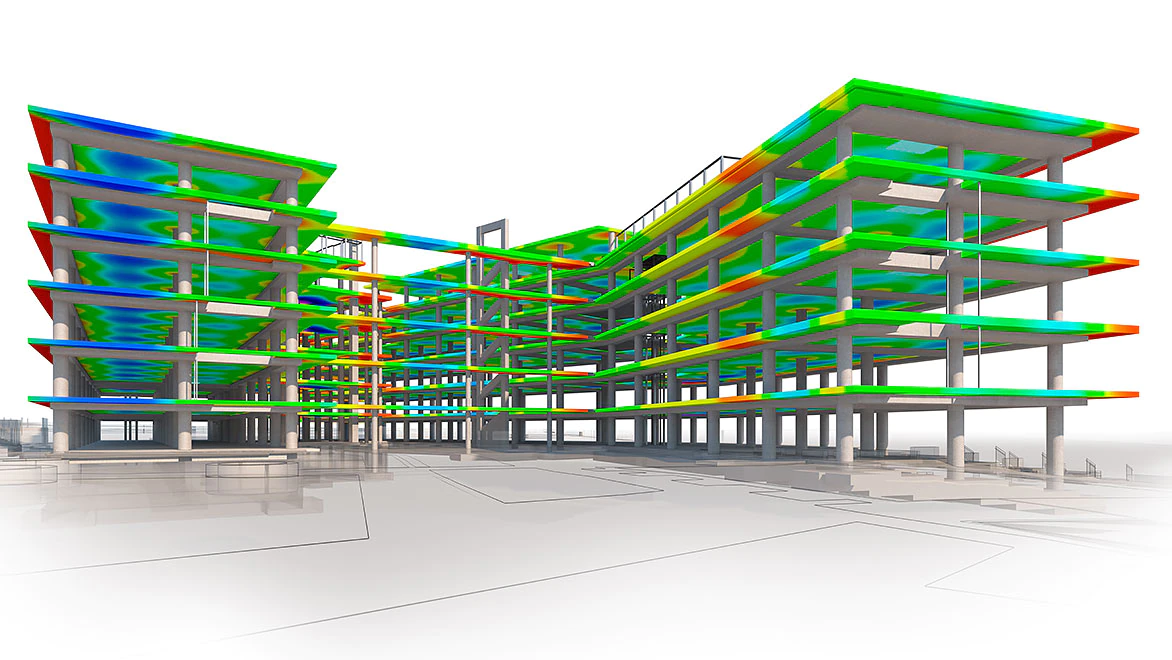
branch of Civil Engineering dealing primarily with the design and construction of structures (such as bridges, buildings, dams
The Department of Civil Engineering at the Federal University of Technology, Minna (FUT Minna), established in 1986, is a leading hub for engineering education and research within the School of Infrastructure, Process Engineering and Technology (SIPET). Committed to global excellence, the Department delivers high-quality training through its B.Eng., PGD, M.Eng., and Ph.D. programmes, designed to equip graduates with the knowledge and skills required to address complex infrastructure and environmental challenges. With strong emphasis on innovation, digital engineering tools, and interdisciplinary collaboration, students benefit from a modern curriculum supported by advanced facilities, including a dedicated software design studio. Core specializations span Structural Engineering, Water Resources and Environmental Engineering, Geotechnical Engineering, and Transportation Engineering, areas critical to sustainable development worldwide. The Department actively promotes research, industry engagement, and the application of Information and Communication Technology (ICT) in engineering practice. Through these efforts, it continues to produce globally competitive engineers and researchers who drive sustainable infrastructure development, contribute to technological advancement, and provide impactful solutions across Nigeria and the international community.
Unified Tertiary Matriculation Examination (UTME)
Candidates are required to obtain five (5) credits at O’ level in not more than two sittings, in English Language, Mathematics, Physics, Chemistry, and any other science subject. (e.g. Further Mathematics, Geography, Technical Drawing, Building Technology, Biology or Agricultural Science). In addition, they should obtain scores higher than or equal to the JAMB university admission minimum. In addition, candidates are expected to obtain a minimum score at the University Post UTME examination.
Direct Entry
Candidates must meet the O’Level requirements in UTME above and obtain a minimum score at the University Post UTME examination.
Also, one of the following additional qualifications is required.
Programme Structure
The Programme workload for students includes combination of: the conventional formal university lectures; tutorials; practical sessions; laboratory work, Seminars and Project. Furthermore, periodically at 200, 300, 400 and 500 levels, Civil Engineering students will go on excursion to Civil Engineering related fields for industrial work experience. At 500 level, students are expected to carry out independent project in their areas of specialization.
Civil Engineering students will be evaluated through:
Duration of the Programme
The Bachelor of Engineering Programme in Civil Engineering is normally a five-year Programme (100-500 levels). However, direct entry candidates normally spend four years (A’ level, and OND Candidates) or three years (HND candidates).
The Programme is structured in such a way that all Engineering students offer the same basic courses at 100 and 200 levels in order to prepare them for the Engineering profession. The 300 to 500 level courses are more detailed and focus towards training in Civil Engineering.
A student cannot stay beyond one hundred and fifty percent (150%) of the normal duration of the Programme (i.e. 7.5, 6 and 4.5 sessions for 5, 4 and 3 year Programme respectively).
The Department presently has full Accreditation status by both the Nigerian Universities Commission (NUC) and Council for the Regulation of Engineering in Nigeria (COREN)
The Department is currently headed by Engr. Prof. M Saidu. Some of the Principal Officers of the Department include: Exam. Officer – Engr. Dr. H. S. Abdulrahman, PG Coordinator –Engr. Dr. M. Abubakar.
Research grants won by the Department of Civil Engineering
| S/No | Name of Research | Research Number | Amount (N) |
| 1 | Development of an Advanced Public Transportation System for captive commuters in Urban Arterials in Minna, Nigeria |
TETF/DR&D/CE/NRF/UNI/ MINNA/STI/VOL.1/B5 |
33,250,000.00 |
| 2 | Development of Drought Early Warning System for Northern Nigeria |
TETFund/DR&D/CE/NRF/CC/ 06/VOL1 |
28,000,000.00 |
| 3 |
Investigating the Effect of Fertilizers Applications on Groundwater Quality in an Unconfined Aquifer |
IBR | 1,400,000.00 |
| 4 | Development of Novel Materials and Technologies for the Removal of Emerging Pollutants from Water and Waste Water Sources | TETFund NRF |
42, 280,150:00
|
The under listed are list of researches won by the department in collaboration with other National and International Partners.
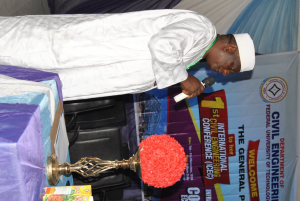
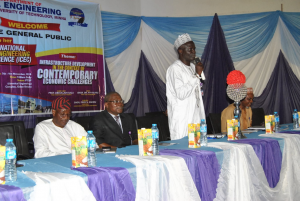
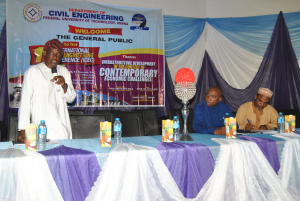
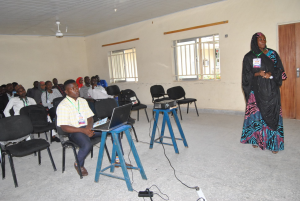
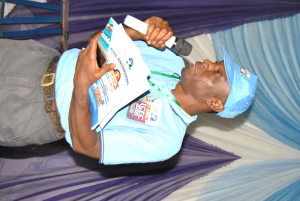
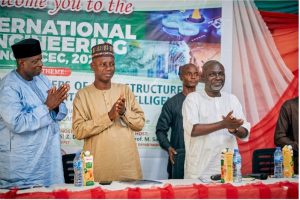
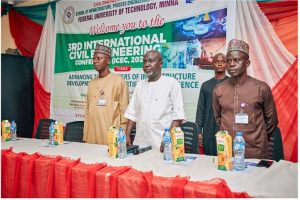
The department organized Biennial Civil Engineering Conference. Below are some pictures of the various events
Programme Educational Objectives (PEOs) describe what graduates are expected to achieve within a few years after graduation. These objectives are reviewed regularly to ensure they meet industry and societal needs.
The following are the PEOs of the Department:
PEO 1: Graduates will demonstrate technical competence and problem-solving abilities to succeed in civil engineering practice, research, or related fields.
PEO 2: Graduates will design civil engineering solutions that integrate functionality, aesthetics, safety, cost-effectiveness, and sustainability, guided by sound engineering principles and ethical standards.
PEO 3: Graduates will engage in lifelong learning through further education, professional certification, and continuous skill development.
PEO 4: Graduates will assume leadership roles in their professions, communities, and interdisciplinary teams.
PEO 5: Graduates will apply entrepreneurial and innovative thinking to create value, generate employment, and support sustainable economic development.
The Civil Engineering programme at FUT Minna is designed to ensure that at the point of graduation, our students have attained the following competencies:
PO 1: Engineering Knowledge: Apply knowledge of mathematics, science, engineering fundamentals, and an engineering specialization to the solution of complex civil engineering problems.
PO 2: Problem Analysis: Identify, formulate, research literature, and analyze complex engineering problems reaching substantiated conclusions using first principles of mathematics, natural sciences, and engineering sciences.
PO 3: Design/Development of Solutions: Design solutions for complex engineering problems and design systems, components, or processes that meet specified needs with appropriate consideration for public health and safety, cultural, societal, and environmental considerations.
PO 4: Investigation: Conduct investigations of complex problems using research-based knowledge and research methods including design of experiments, analysis, and interpretation of data, and synthesis of information to provide valid conclusions.
PO 5: Modern Tool Usage: Create, select, and apply appropriate techniques, resources, and modern engineering and IT tools, including prediction and modeling, to complex engineering activities, with an understanding of the limitations.
PO 6: The Engineer and Society: Apply reasoning informed by contextual knowledge to assess societal, health, safety, legal, and cultural issues and the consequent responsibilities relevant to professional engineering practice.
PO 7: Environment and Sustainability: Understand the impact of professional engineering solutions in societal and environmental contexts and demonstrate knowledge of and need for sustainable development.
PO 8: Ethics: Apply ethical principles and commit to professional ethics and responsibilities and norms of engineering practice.
PO 9: Individual and Teamwork: Function effectively as an individual, and as a member or leader in diverse teams and in multi-disciplinary settings.
PO 10: Communication: Communicate effectively on complex engineering activities with the engineering community and with society at large, such as being able to comprehend and write effective reports and design documentation, and make effective presentations.
PO 11: Project Management and Finance: Demonstrate knowledge and understanding of engineering and management principles and apply these to one’s own work, as a member and leader in a team, to manage projects and in multidisciplinary environments.
The B.Eng. Civil Engineering programme has consistently maintained a healthy accreditation status with both the Nigerian Universities Commission (NUC) and the Council for the Regulation of Engineering in Nigeria (COREN), with FULL accreditation awarded to the department.
The Department offers undergraduate and postgraduate programmes. At the undergraduate level, it runs the Bachelor of Engineering (B.Eng.) in Civil Engineering. At the postgraduate level, the Department offers the Postgraduate Diploma (PGD) in Civil Engineering, as well as Master’s (M.Eng.) and PhD degrees in Structural, Geotechnical, Transportation, and Water & Environmental Engineering.
Students Statistics
The first set of Postgraduate Students are due for resumption during the first semester of the 2025/2026 Academic Calendar. While undergraduate student statistics in the department for the 2024/2025 Academic Session are as depicted in the Table below:
Table 1: Department of Civil Engineering Students Distribution.
|
GENDER |
|||
|
LEVEL |
MALE |
FEMALE |
TOTAL |
|
100 |
249 |
19 |
268 |
|
200 |
209 |
19 |
228 |
|
300 |
255 |
24 |
279 |
|
400 |
202 |
21 |
223 |
|
500 |
209 |
19 |
228 |
|
PGD |
6 |
0 |
6 |
|
M.Eng |
42 |
5 |
47 |
|
PhD |
40 |
4 |
44 |
The Department actively maintains professional ties with regulatory bodies and industry leaders such as the Council for the Regulation of Engineering in Nigeria (COREN) and the Nigerian Society of Engineers (NSE) to ensure our curriculum remains aligned with global best practices. Beyond these established professional relationships, the department is aggressively pursuing new Memoranda of Understanding (MoUs) with frontline construction firms, international research institutes, and sister universities. These emerging linkages are designed to facilitate student internships (SIWES), joint research ventures, and faculty exchange programmes, reinforcing our position as a collaborative hub for infrastructural innovation. Our doors remain wide open to global and local partners ready to co-create sustainable engineering solutions for the 21st century.
Include:
10%
The under listed are list of researches won by the department in collaboration with other National and International Partners.
Key community service initiatives include:
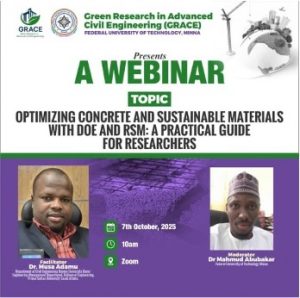
The student resources can be found in https://bit.ly/FUTMinna_CIE_ResourceHub