
Computer engineering has traditionally been viewed as a combination of both computer science (CS) and electrical engineering (EE). It has evolved over the past three decades as a separate, although intimately related discipline. The discipline is solidly grounded in the theories and principles of computing, mathematics, science, and engineering and it applies these theories and principles to solve technical problems through the design of computing hardware, software, networks, and processes. Computer engineers are electrical engineers with additional training in the areas of software design and hardware-software integration while turning less attention on power electronics and physics. They are involved in all aspects of computing, from the design of individual microprocessors, personal computers and supercomputers, to circuit design, as well as the integration of computer systems into other kinds of systems.
Ideally, common computer engineering tasks include writing embedded software for real-time microcontrollers, working with analog sensors, and designing mixed signal circuit boards, VLSI chips and operating systems. Computer engineers are also well suited for research in the field of robotics, which relies on using computers together with other electrical systems.
The Department of Computer Engineering was established on the 13th of February, 2009. The department emerged from the department of Electrical and Computer Engineering, in the School of Engineering and Engineering Technology (SEET) where it existed as an option. The Department was located as one of the departments in a newly created School of Information and Communication Technology (SICT) in the same year. In April 2013, the Senate of Federal of University of Technology, Minna relocated the department back to School of Engineering and Engineering Technology (SEET) due to accreditation requirements of the Council for the Regulation of Engineering in Nigeria (COREN). In 2017, the School of Engineering and Engineering Technology was divided into School of Electrical Engineering and Technology (SEET) and School of Infrastructure, Process Engineering and Technology (SIPET). Computer Engineering department now belongs to the School of Electrical Engineering and Technology, alongside Electrical & Electronics, Telecommunication and Mechatronics Engineering departments. The Department of Computer Engineering encourages research activities and staff development as well as adequate practical/industrial exposure for her students. The Department awards B. Eng., M. Eng and PhD degrees in Computer Engineering.
PAST AND PRESENT HEADS OF THE DEPARTMENT
The following Staff had served as Examination Officers. They are Engr. Michael Akogbe, Engr. B. U. Umar, Engr. Danlami Maliki and Engr. Idris Aji Dauda who is the current Examination Officer. Postgraduate Coordinators from inception are: Dr. Ahmed Aliyu, Dr. James Agajo; and Dr. I. M. Abdullahi who is the current PG Coordinator.

Vision
The Department of Computer Engineering envisioned becoming a world class academic centre of excellence in Computer Engineering Training and research.
Mission
The Department of Computer Engineering will build capacity and develop human capital to high level through pragmatic and dynamic training, research and developmental services of high standards in the field of Computer Engineering that meet the demands of the society and will stand the test of time and space.
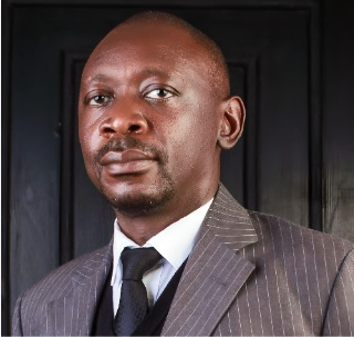
Engr. Dr. Eustace Manayi Dogo holds BSc and MEng degrees in Electrical Engineering from St. Petersburg State Technical University, Russia (Now known as Peter the Great St. Petersburg Polytechnic University, Russia) and a PhD degree in Electrical and Electronic Engineering (Artificial Intelligence and Machine Learning) from the University of Johannesburg, South Africa. He is a Registered Engineer with the Council for the Regulations of Engineering in Nigeria (COREN).
Engr. Dr. Eustace Dogo is currently a Senior Lecturer and Head of Computer Engineering Department, Federal University of Technology, Minna since January 2023. He has extensive knowledge in industry, research, training and teaching. He has over ten years of industrial experience working in Russia, Europe and Nigeria, in the oil and gas and ICT sectors. He is currently an active undergraduate and postgraduate supervisor with over 10 years academic experience, and has authored and co-authored over 50 reputable journals, conferences and scholarly research book chapters in his areas of interest.
Engr. Dr Eustace Dogo is a reviewer in several high impact peer- reviewed journals and has won some awards both at the national and international levels. He recently won over 70 million Naira TETFund NRF research grants in 2021/2022 cycle. His broad research interest includes theoretical and applied Machine Learning, Deep Learning, Intelligent Systems, Cloud Computing and Emerging Technologies
Members of staff of the department are actively engaged in various community and consultancy services in and outside the University. They occupy membership and leadership positions in the Federal Road Safety Corps; Old Students Associations, Religious organizations and denominations, Resource Persons to Nigerian Communication Commission (NCC); Petroleum Development Trust Fund Overseas Scholarship Scheme, (PTDF), COREN Resource Person for the Accreditation of Computer Engineering, External Moderation of Postgraduate Diploma’s in Information Technology, National Open University of Nigeria (NOUN), Technical staff for JAMB UTME examinations. Staff are also external examiners of Bachelor and higher degrees within and outside the country.
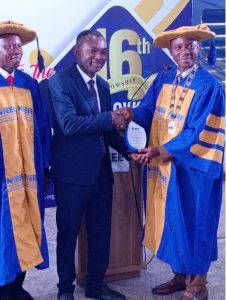
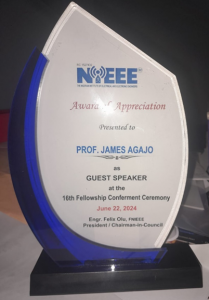
Plaque presentation to Prof James Agajo as Guest Speaker at 16th Fellowship Conferment Ceremony of the Nigerian Institute of Electrical and Electronics Engineers.
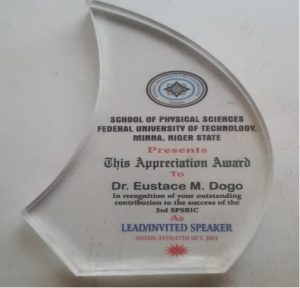
Plaque presentation to Dr. Eustace M. Dogo as Lead/Invited Speaker: “The Fourth Industrial Revolution and Pandemic Management” at the 2021 School of Physical Sciences Biennial International Conference (SPSBIC-2021) 25th – 28th October 2021, Federal University of Technology, Minna, Nigeria,
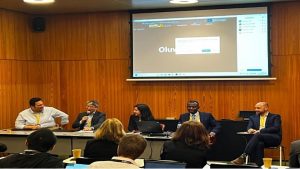
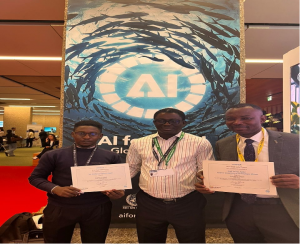
The competition was intense, with over 800 research groups participating globally. From these, only 10 were selected for the final contest in Geneva, where the WINEST FUT Minna team was declared the winner in the Use Case 6.0 category under the Sustainable Development Goal (SDG) initiative of the United Nations.
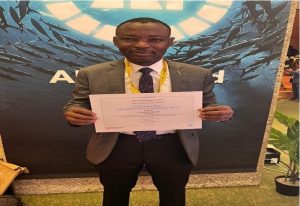
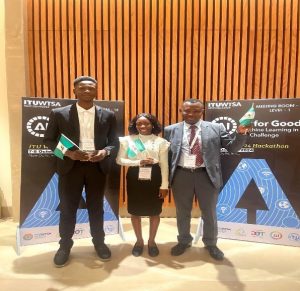
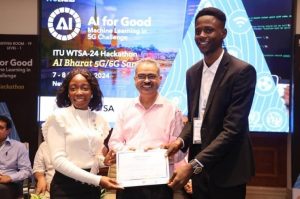
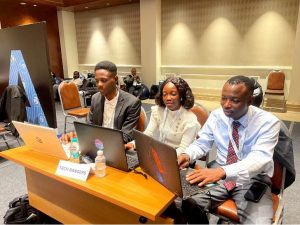
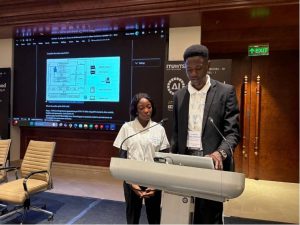
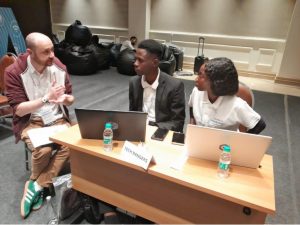
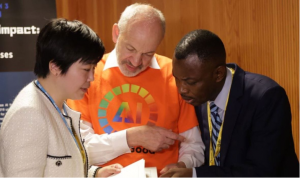
The WINEST research group was also recently in October 2024 representing Nigeria in India at the World AI in 5G/6G contest in New Delhi. The prestigious event is organised by ITU in collaboration with the India Government Ministry of Communications. Mr Frank Chukwubuikem Ebeledike and Miss Eniola Eunice Alao and their mentor Prof James Agajo represented Federal University of Technology Minna at the event.
Below are some picture snapshots at the events in New Delhi, India and Geneva, Switzerland:
Presented by Dr. Eustace M. Dogo as Lead/Invited Speaker : “The Fourth Industrial Revolution and Pandemic Management” at the 2021 School of Physical Sciences Biennial International Conference (SPSBIC-2021) 25th – 28th October 2021, Federal University of Technology, Minna, Nigeria
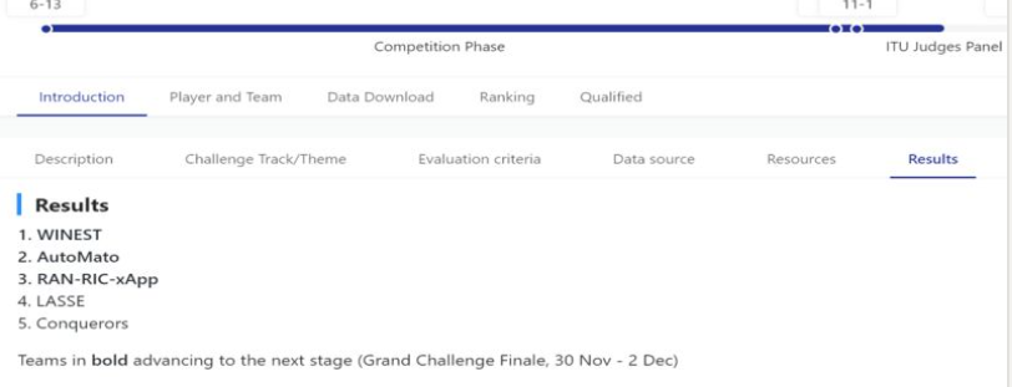
Winners
WINEST Research group Placed 1st Position in ITU AI/ML in 5G Challenge (Problem Statement 014)
Special Recognition
Team WINEST Reseach Group from the department of Computer Engineering were privileged to be interviewed via a global platform on AI for Good Machine Learning in 5G Challenge Perspectives on the ITU experience by the International Media Production and Live Webcasting alongside members of my research team “Wireless Networking and Embedded System Technology(WINEST)”. Some members of the team are Mr. Blessed Guda and Miss Yemisi Akinseli, all students. Every team member had a course to say something about his/her experience with regard to working and engaging the International Telecommunication Union (ITU) during the interview session.
Honorable Mention in the “ITU AI/ML in 5G Grand Challenge
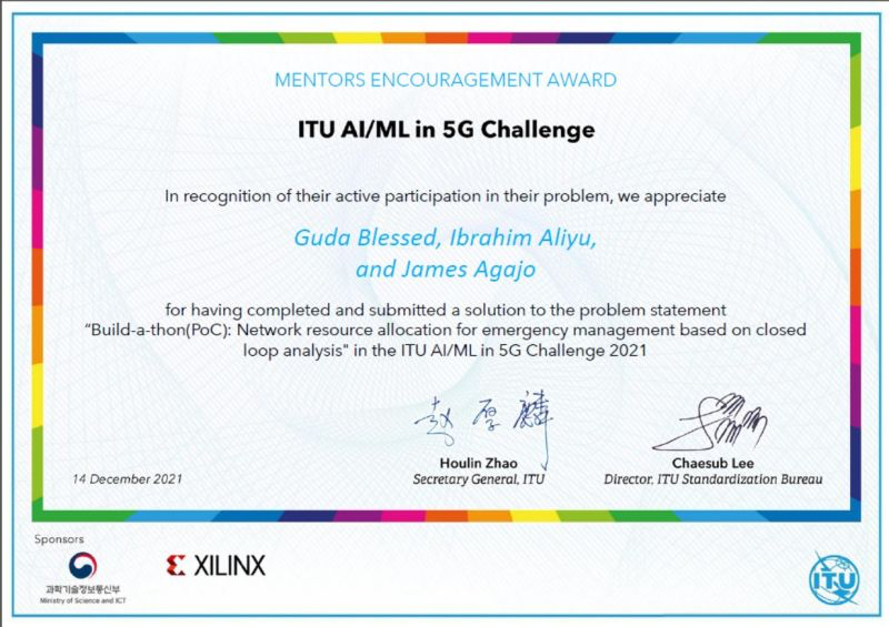
WINEST Research Group from Computer Engineering got a Honorable Mention in the “ITU AI/ML in 5G Grand Challenge Finale” among 1600+ participants from 82 countries.
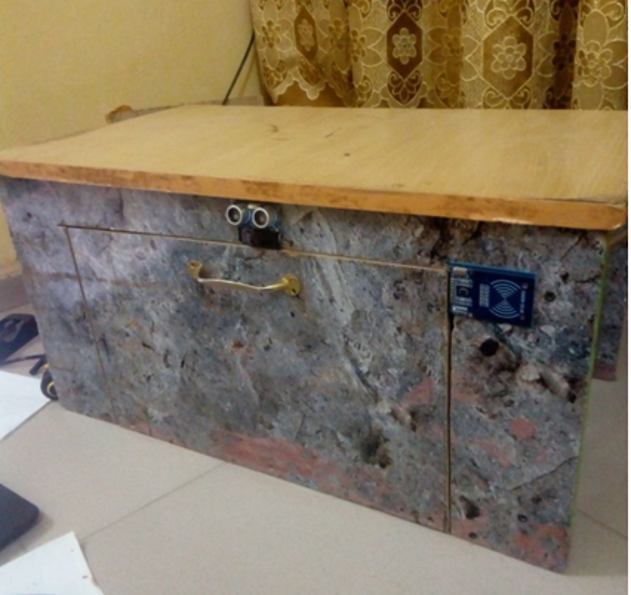
They participated in the “Build a thon: ITU-AI-ML-in-5G-Challenge/Intent-Driven-Closed-Loops-for-Autonomous-Networks” challenge hosted by ITU Focus Group – Autonomous Networks (FG-AN). We have developed Intent-Driven-Closed-Loops-for-Autonomous-Networks.

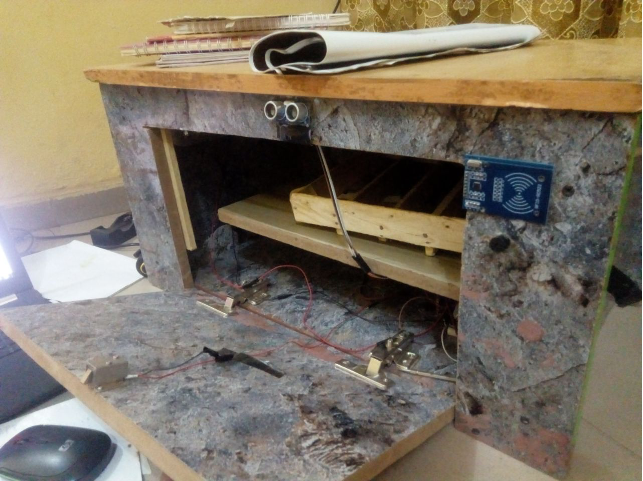

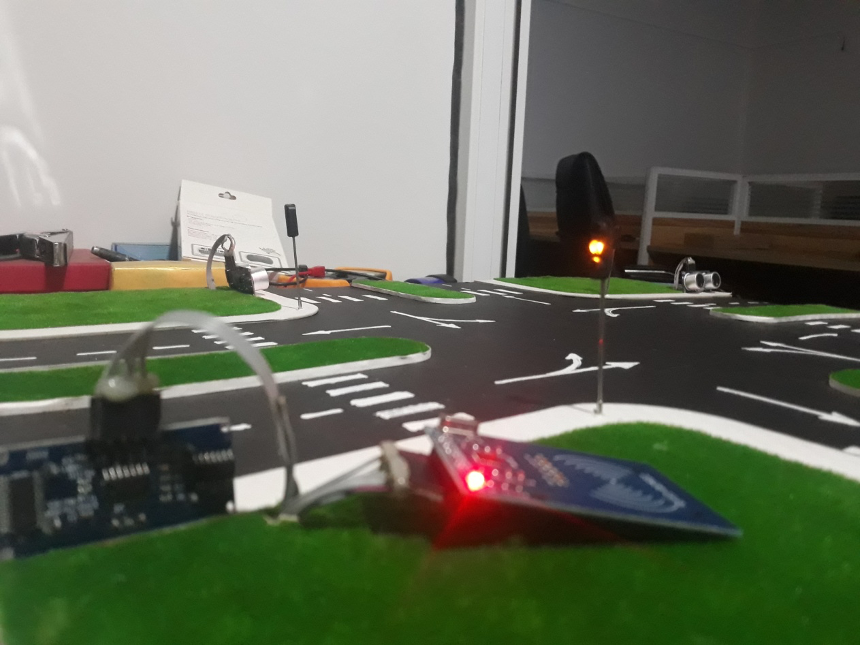
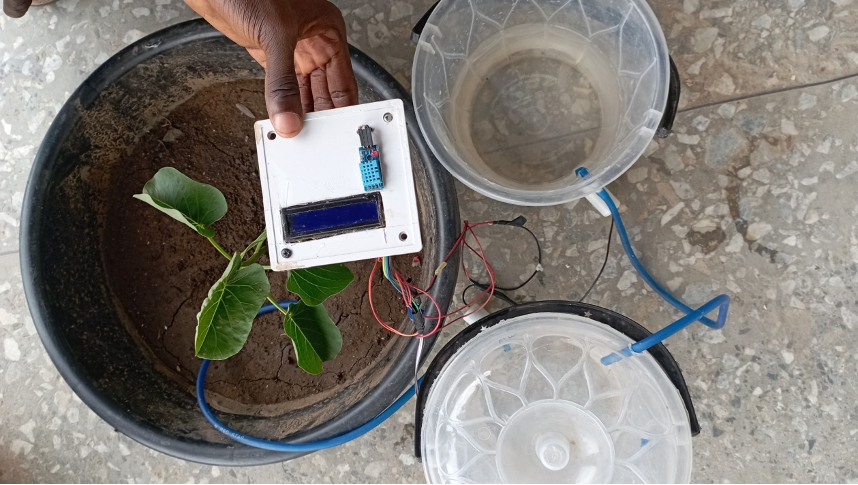
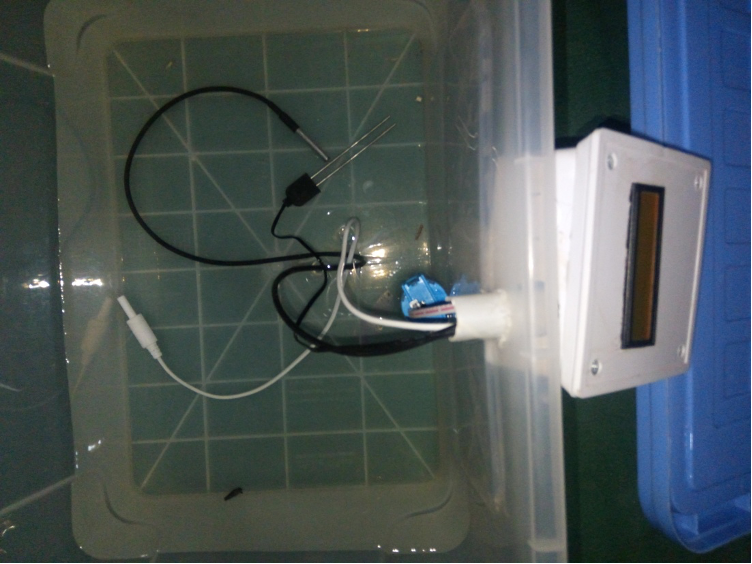
Research Work Publications (Scopus Indexed): The staff of the department has over 200 combined articles published in reputable national and international journals and conference proceedings indexed by Scopus.
H-indexed articles by Google Scholar: Over 200 articles have been published by the departmental staff and highly indexed in Google Scholar.
The department in the past few years has won grants that worth over 100 Million Naira to the university. Some of these grants are listed below:
Research Title: Development of an Anti-Theft Oil Pipeline Vandalism Detection, Tracking and Decentralized Management System for Secure Distribution of Petroleum Products
Research Topic: Development of Drought Early Warning System for Northern Nigeria
Research Title: Design and Fabrication of a Secure, Smart and Intelligent Electronic Voting System (SSIEVS).
The department is in collaboration with various academic, public agencies and research institutions inside and outside the country. They include Federal Road Safety Commission (FRSC), National Information Technology Development Agency (NITDA), Nigerian Communications Commission (NCC), and other private ICT companies in Nigeria.
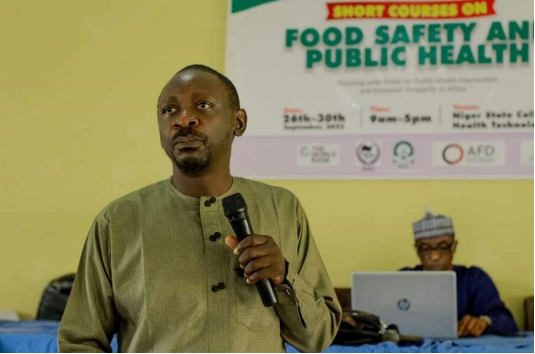
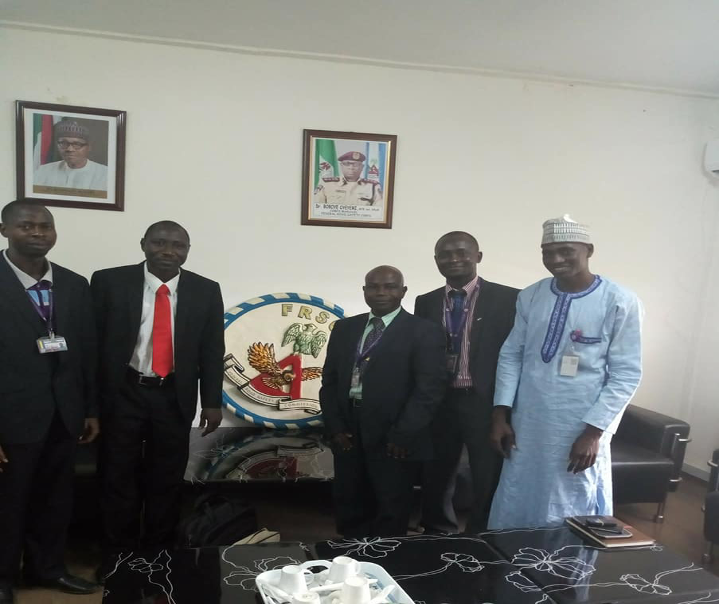
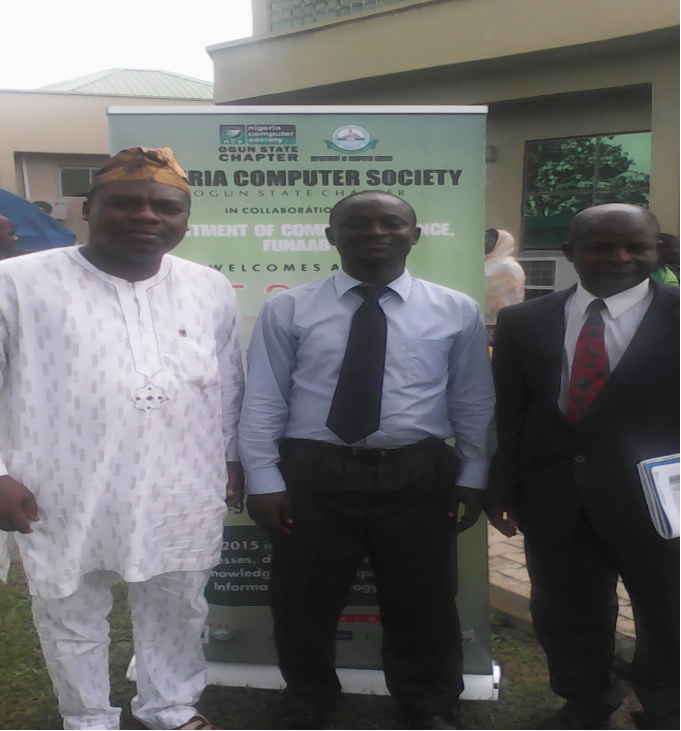
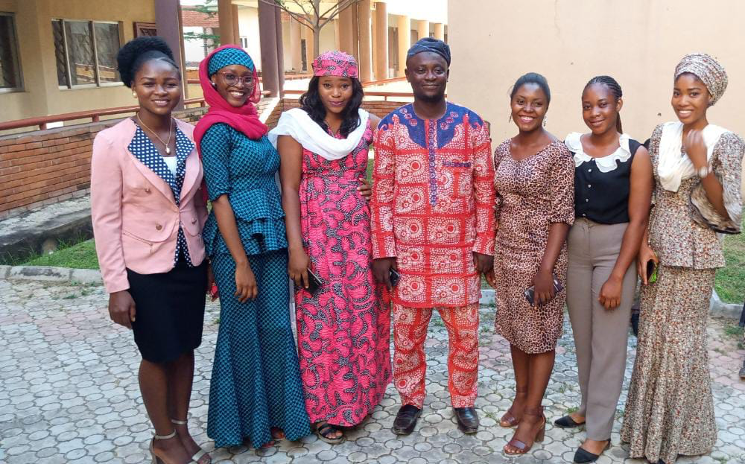
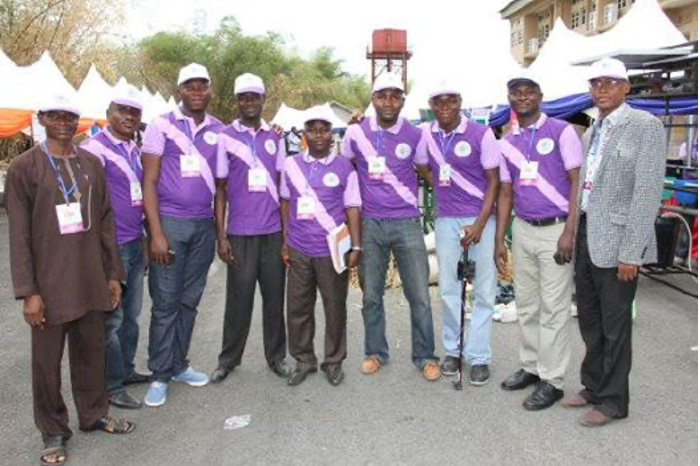
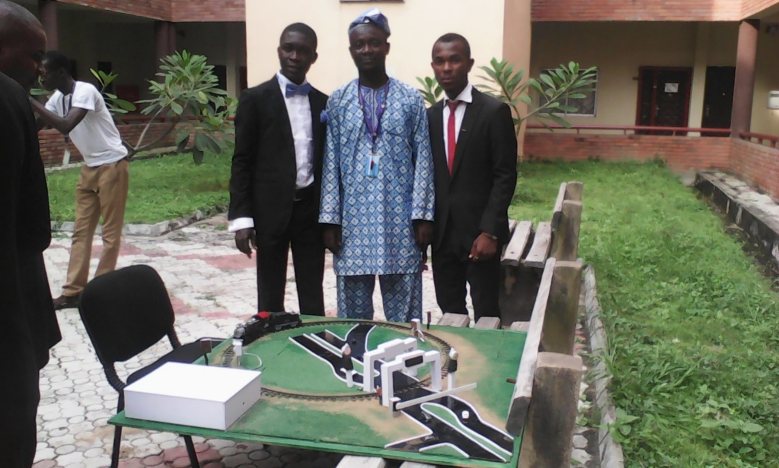
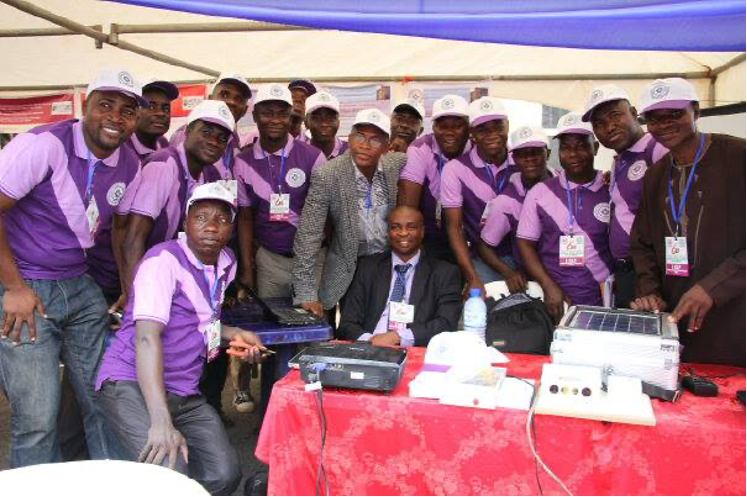
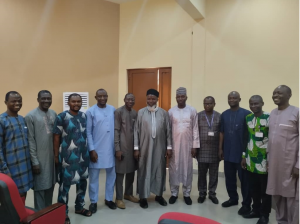
Photo Gallery showing Computer Engineering Department Exhibition Stand, Industrial Visit Conference Research attendance and staff photos as shown below.
Postgraduate Degree programme
The postgraduate programme recorded a remarkable progress in 2019/2020 and 2021/2022 academic sessions. Three of the departmental staff successfully had their PhD viva.
The following are the four (4) PEOs for Computer Engineering programme and are outlined in Table 1. These are attributes expected of our graduates between 3 – 5 years after they graduate.
The PEOs are consistent with the vision and mission of the University.
Table 1: Programme Educational Objectives (PEOs)
|
SN |
Attribute |
Outcome/Objective |
|
1. |
Start-up and innovative Entrepreneurs |
Graduates will become managers in the industries associated with engineering and professional engineers starting-up and growing their own new companies. They will become recognized experts working in government, private and consulting firms, and international organizations both in the country and abroad; addressing some of the challenging problems of our times. With the right skill and reputation as a source of innovative solutions to complex problems, graduates will become technology leaders in start-up Tech-companies based on societal demands, national and international needs, in a competitive global economy. |
|
2. |
Researchers |
Graduates are trained to be leading researchers who create and disseminate new knowledge in Computer Engineering. They will complete Masters and PhD programmes in leading universities around the world by conducting original research in related disciplines or interdisciplinary topics, contribute to the scientific community with novel and cutting-edge research activities, and continue their careers in permanent academic position in engineering, research development, production, operations and management departments in Nigeria and companies world-wide, using their skills and engineering knowledge to solve complex technical problems, take initiatives, develop and execute projects, collaborate with other teams and take responsibilities of a leader. |
|
3. |
Lifelong Learners |
Graduates will pursue lifelong learning in generating innovative engineering solutions using research and complex problem-solving skills. |
|
4. |
Ethical Professional Engineers |
Graduates will demonstrate technical competency and leadership in order to work as registered professional engineers act ethically, adhere to standards, and be committed to the welfare of employees and the general public. |
The PEOs are derived from the vision and mission, which are published in the University’s Students’ Handbook.
Programme Outcomes
The programme has adopted the COREN POs. At the time of graduation from the degree programme, our students are expected to have the ability to do the following, as outlined in Table 4:
Table 4: List of the Twelve (12) Adopted COREN Programme Outcomes
|
POs |
Attributes |
Programme Outcome Description |
|
PO1 |
Engineering Knowledge |
Apply knowledge of mathematics, science, engineering fundamentals and an engineering specialization to the solution of developmental and complex engineering problems |
|
PO2 |
Problem Analysis |
Identify, formulate, research literature and analyse developmental and complex engineering problems reaching substantiated conclusions using first principles of mathematics, natural sciences and engineering sciences |
|
PO3 |
Design and Development of Solutions |
Proffer solutions for developmental or complex engineering problems and design systems, components or processes that meet specified needs with appropriate consideration for public health and safety, cultural, societal and environmental considerations |
|
PO4 |
Investigation |
Conduct investigation into developmental or complex problems using research-based knowledge and research methods including design of experiments, analysis and interpretation of data, and synthesis of information to provide valid conclusions. |
|
PO5 |
Modern Tool Usage |
Create, select and apply appropriate techniques, resources and modern engineering and ICT tools, including prediction, modelling and optimization to developmental and complex engineering activities, with an understanding of the limitations. |
|
PO6 |
The Engineer and Society |
Apply reasoning informed by contextual knowledge including Humanities and Social Sciences to assess societal, health, safety, legal and cultural issues and the consequent responsibilities relevant to professional engineering practice. |
|
PO7 |
Ethics |
Apply ethical principles and commit to professional ethics and responsibilities and norms of engineering practice, including adherence to the COREN Engineers Code of Conducts. |
|
PO8 |
Individual and Team work |
Function effectively as an individual, and as a member or leader in diverse teams and in multi-disciplinary settings. |
|
PO9 |
Communication |
Communicate effectively on developmental or complex engineering activities with the engineering community and with society at large, such as being able to comprehend and write effective reports and design documentation, make effective presentations, and give and receive clear instructions. |
|
PO10 |
Project Management and Finance |
Demonstrate knowledge and understanding of engineering, management and financial principles and apply these to one’s own work, as a member and leader in a team, to manage projects and in multi-disciplinary environments. |
|
PO11 |
Environment and Sustainability |
Understand the impact of professional engineering solutions within the context of the society and environment, and demonstrate knowledge of and need for sustainable development. |
|
PO12 |
Lifelong learning |
Recognize the need for, and have the preparations and ability to engage in independent and lifelong learning in the broadest context of technological and social changes. |